If you spend enough time in the Print on Demand world, you’ll notice something strange.
Most people are obsessing over designs…
…while completely ignoring the thing that actually determines whether a product has a chance of selling in the first place.
The product itself.
Not every POD product is equal.
Not even close.
Some products are naturally easier to sell because they fit:
- impulse buying behavior
- emotional buying behavior
- gifting behavior
- identity-based buying
Others?
They look cool in mockups but almost nobody actually buys them.
And that’s one of the biggest reasons most POD sellers struggle.
They’re building products around what they think looks interesting instead of understanding what normal buyers actually purchase.
That’s the game.
Not artistic expression.
Not “creativity”.
Not making designs for other POD sellers to compliment in Facebook groups.
The game is understanding:
- buyers
- emotions
- products
- positioning
- timing
Once you understand that…
POD gets much simpler.
The Biggest Mistake POD Beginners Make
Most beginners start backwards.
They:
- Create random designs
- Throw them onto random products
- Upload them everywhere
- Hope something magically works
That’s not strategy.
That’s gambling.
Real POD sellers think differently.
They start with:
- Who would buy this?
- Why would they buy this?
- What product makes the most sense for that buyer?
- What emotional outcome does this product create?
That’s a completely different thought process.
And once you start thinking like that, you stop wasting massive amounts of time.
The Products That Actually Sell
Let’s be honest.
There are now thousands of POD products available.
Some are genuinely good.
Some are completely ridiculous.
Just because a POD supplier offers a product doesn’t mean there’s actual demand for it.
This is where people get trapped.
They see “new” and assume it means “profitable”.
Usually it doesn’t.
The products that consistently sell tend to fit a few important categories:
- practical
- emotional
- giftable
- identity-driven
- visible
- easy to understand immediately
That last one matters a lot.
If someone has to “figure out” your product…
…it usually won’t sell.
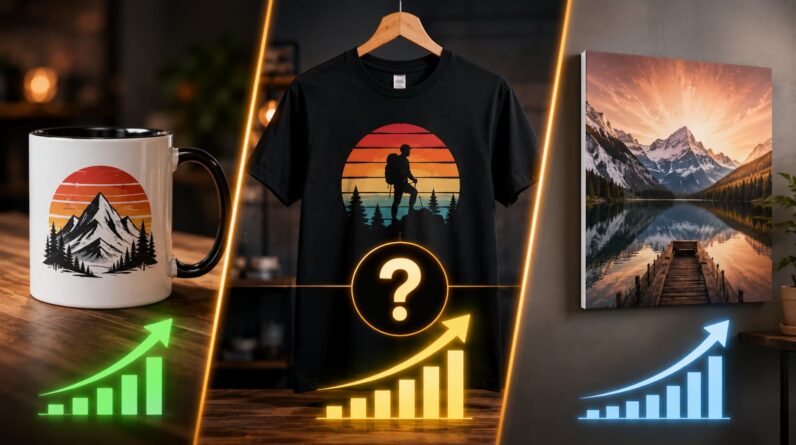
T-Shirts Still Dominate
People love pretending t-shirts are “too saturated”.
They’ve supposedly been “dead” for years.
Meanwhile…
People are still buying millions of them.
Why?
Because shirts fit identity.
People wear:
- beliefs
- humor
- pride
- hobbies
- professions
- tribes
- relationships
A shirt is wearable identity.
That’s powerful.
And unlike many other POD products:
- sizing is familiar
- buying behavior is established
- people already understand the value
The mistake isn’t selling shirts.
The mistake is selling bad shirts with weak ideas.
Most POD shirts fail because:
- the phrase is weak
- the targeting is vague
- the design is unreadable
- the message has no emotional pull
Not because “shirts are saturated”.
That’s mostly cope from people who never learned how to market properly.
Mugs Are Better Than Most People Think
Mugs quietly make a lot of money.
Especially:
- gifting mugs
- emotional mugs
- workplace mugs
- relationship mugs
- seasonal mugs
Why?
Because mugs are easy.
People don’t overthink mug purchases.
A mug feels:
- inexpensive
- safe
- practical
- useful
That lowers resistance massively.
The best mug ideas usually:
- communicate quickly
- create emotional recognition
- feel giftable
Complicated designs usually perform worse.
Simple wins.
Especially on mugs.
Canvas Prints Can Be Monsters
Canvas products are interesting because they operate differently psychologically.
People don’t buy canvas for utility.
They buy it for:
- identity
- inspiration
- emotional atmosphere
- home personalization
That’s a completely different buying mechanism.
Canvas works best when:
- the message feels emotionally significant
- the artwork feels “display worthy”
- the mockups look premium
This is why mockups matter far more for canvas than many other products.
People need to visualize it hanging in their home.
If your mockups look cheap…
…the product feels cheap.
Seasonal Products Crush Generic Products
This is one of the biggest lessons most POD sellers learn too late.
Seasonality matters.
Massively.
Mother’s Day.
Father’s Day.
Christmas.
Halloween.
Valentine’s Day.
These events create:
- urgency
- emotional buying
- gifting behavior
- purchase justification
That combination is extremely powerful.
People spend differently during seasonal periods.
The emotional intensity increases.
And emotional intensity drives purchases.
This is why many smart POD sellers build entire yearly calendars around seasonal events.
Because seasonal buyers are easier to convert than cold generic buyers.
The “Cool Product” Trap
This kills so many POD stores.
A supplier releases some:
- weird gadget
- trendy object
- random novelty product
And POD sellers rush toward it because it looks “different”.
Different doesn’t equal profitable.
Most weird novelty products fail because:
- buyers don’t understand them
- there’s no established buying behavior
- they don’t solve a real emotional or practical need
You have to remember:
Normal people are not sitting around excited about “new POD products”.
POD sellers are.
Huge difference.
Buyers care about:
- themselves
- emotions
- gifts
- relationships
- identity
That’s it.
The product is just the delivery vehicle.
Why Most POD Products Don’t Sell
Now let’s get brutally honest.
Most POD products fail because sellers don’t understand marketing fundamentals.
Not design fundamentals.
Marketing fundamentals.
There’s a massive difference.
Most failing products suffer from one or more of these problems:
Weak Messaging
Nobody cares.
That’s the harsh truth.
The phrase:
- isn’t emotional
- isn’t specific
- isn’t identity-driven
- doesn’t trigger recognition
So buyers scroll past it instantly.
Bad Product Match
The product doesn’t fit the message.
Some ideas work brilliantly on shirts.
Some work better on mugs.
Some belong on wall art.
A lot of POD sellers randomly slap the same design onto 25 products and hope something sticks.
That’s lazy strategy.
No Buyer Understanding
This is huge.
Most sellers never deeply think about:
- who the buyer is
- why they’re buying
- what emotional state they’re in
That’s where sales come from.
Not Canva tricks.
Weak Mockups
Mockups sell products.
Especially online.
Your customer cannot physically touch the product.
So the mockup becomes the experience.
Cheap mockups:
- lower perceived value
- reduce trust
- kill emotional connection
Good mockups increase conversion massively.
No Emotional Trigger
Emotion drives purchases.
Almost every successful POD product connects to:
- humor
- pride
- nostalgia
- love
- belonging
- identity
- frustration
- relationships
Products without emotional triggers usually die quietly.
The Smart Way To Approach POD Products
Instead of asking:
What product should I make?
Ask:
What emotional outcome am I trying to create?
That changes everything.
Because now:
- product choice becomes strategic
- designs become clearer
- messaging becomes easier
- conversions improve
The best POD sellers understand they’re not really selling products.
They’re selling:
- emotional reactions
- identity reinforcement
- moments
- gifts
- self-expression
The physical product is just the container.
Simplicity Wins
This is another hard truth.
Most POD sellers overcomplicate everything.
Complex designs.
Tiny text.
Overloaded graphics.
Five competing ideas on one product.
Meanwhile…
Simple products quietly outperform them.
Simple:
- reads faster
- communicates faster
- converts faster
Especially on mobile.
And most buyers are shopping on mobile now.
If somebody can’t understand your product in about two seconds…
You’re already losing.
The Future Of POD Products
AI will absolutely change the POD landscape.
But not in the way most people think.
AI won’t magically make bad ideas profitable.
It’ll just allow people to create bad products faster.
The advantage will still belong to people who understand:
- psychology
- buyers
- positioning
- emotional marketing
That part doesn’t disappear.
If anything, it becomes even more important.
Because when everyone can generate designs…
…the strategy becomes the real differentiator.
Final Thoughts
The biggest breakthrough most POD sellers need isn’t:
- better software
- more products
- more designs
- more tools
It’s understanding buyers better.
That’s the unlock.
The POD products that actually sell are usually:
- emotionally clear
- easy to understand
- strongly targeted
- matched properly to the buyer
- positioned correctly
That’s the game.
Not uploading 10,000 random products and hoping for luck.
Once you start approaching POD like a marketer instead of a hobby designer…
Everything changes.